Agile development best practices for high-performing teams
Uncover agile development best practices to boost delivery, collaboration, and value for your team with practical, repeatable steps.
Agile is more than just a popular methodology; it's a fundamental shift in mindset that empowers high-performing teams to deliver exceptional value consistently. While the term is ubiquitous, truly implementing its principles requires moving beyond surface-level understanding. With a landscape filled with various frameworks, ceremonies, and techniques, it's easy for teams to get lost in the process rather than focusing on the outcome. This guide is designed to cut through that noise.
We’ve compiled a comprehensive roundup of the 10 most impactful agile development best practices that your team can begin implementing today. This isn't just a list of definitions. For each practice, we provide actionable implementation steps, dive into real-world examples from successful product teams, and offer practical tips to help you navigate common pitfalls. We will explore core frameworks like Scrum and Kanban, essential techniques such as Continuous Integration (CI/CD) and user story mapping, and cultural cornerstones like cross-functional collaboration.
This article is for product managers, designers, and developers who want to do more than just "go through the motions" of agile. Whether you are part of a startup aiming for rapid product-market fit or an established team seeking to refine your delivery pipeline, these insights will equip you to build products faster, smarter, and with a much deeper alignment to your users' actual needs. Let's move beyond the buzzwords and explore the specific practices that separate good agile teams from truly great ones.
1. Scrum Framework
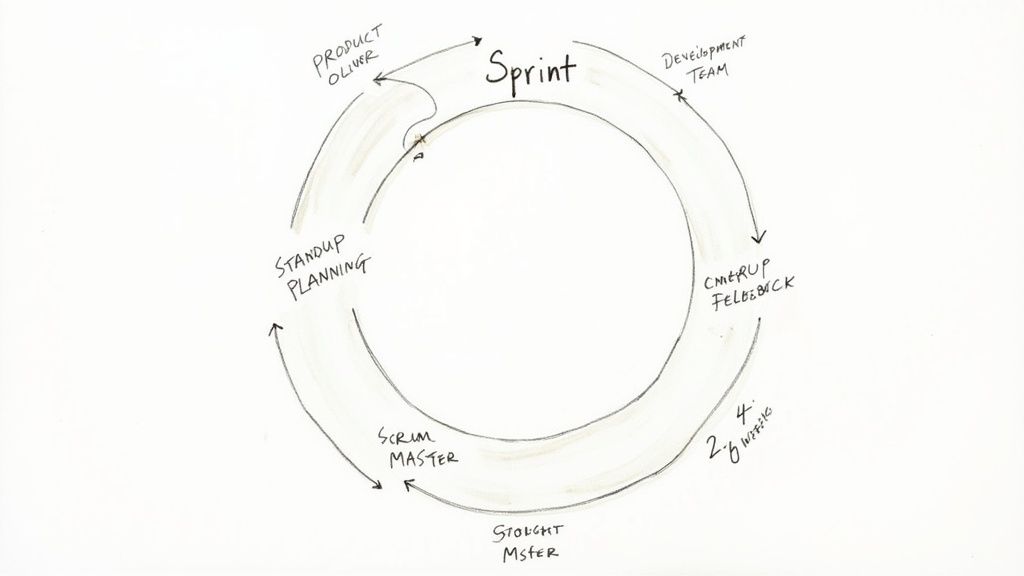
Scrum is a lightweight yet powerful agile framework designed to help teams deliver value in complex product environments. Instead of a single, long development cycle, Scrum breaks work into fixed-length iterations called sprints, which typically last one to four weeks. This structure provides a predictable rhythm for teams to plan, execute, and review their work, making it one of the most foundational agile development best practices.
The framework is built on three core pillars: transparency, inspection, and adaptation. It defines specific roles, including the Product Owner (who represents the stakeholders and prioritizes the backlog), the Scrum Master (who facilitates the process and removes impediments), and the Development Team (who builds the product increment). Regular ceremonies like sprint planning, daily stand-ups, sprint reviews, and retrospectives create a continuous feedback loop, ensuring the team stays aligned and constantly improves.
Why It's a Top Agile Practice
Scrum excels where requirements are likely to change or are not fully understood at the outset. Its iterative nature allows teams to deliver a functional piece of the product at the end of each sprint, gathering real-world feedback early and often. This incremental delivery model reduces risk, increases predictability, and ensures the final product truly meets user needs. Companies like Microsoft and Adobe have successfully adopted Scrum to accelerate innovation and respond faster to market demands.
Actionable Implementation Tips
To effectively implement Scrum, focus on discipline and clear communication. Here are some key tips:
- Keep Sprints Consistent: Maintain a fixed sprint length (e.g., two weeks) to establish a reliable cadence for planning and delivery.
- Empower the Product Owner: Ensure the Product Owner has the authority and availability to make decisive backlog prioritization choices.
- Timebox Ceremonies: Strictly adhere to the time limits for meetings. For example, keep daily stand-ups to a maximum of 15 minutes to maintain focus.
- Embrace Retrospectives: Foster a no-blame environment during retrospectives. The goal is to identify process improvements, not to point fingers. Use this time to generate concrete, actionable steps for the next sprint.
2. Kanban Method
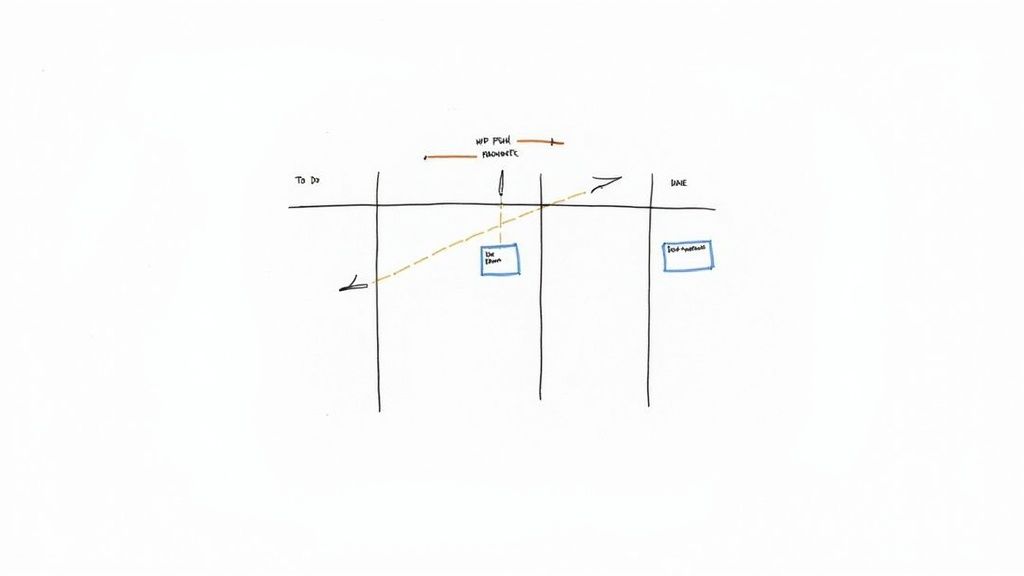
Kanban is a visual workflow management method designed to help teams balance demand with available capacity and improve the flow of work. Originating from the Toyota Production System, Kanban visualizes work items on a board, moving them through predefined stages like To Do, In Progress, and Done. Its core principle is to limit Work-in-Progress (WIP), which prevents bottlenecks and ensures a smooth, continuous delivery cycle. Unlike the time-boxed sprints in Scrum, Kanban focuses on optimizing flow, making it a highly flexible and efficient agile development best practice.
The method emphasizes continuous improvement by making process policies explicit and using feedback loops to refine the workflow. Teams use the Kanban board as a single source of truth to see where work is, identify blockages, and collaborate on moving tasks to completion. By focusing on finishing work rather than starting new work, teams can dramatically reduce lead times and increase predictability.
Why It's a Top Agile Practice
Kanban excels in environments where priorities change frequently and work arrives unpredictably, such as in software maintenance, DevOps, or support teams. Its continuous flow model is perfect for teams that need to deliver value as soon as it's ready, without waiting for a sprint to end. This adaptability allows teams to respond to changing market needs rapidly. Companies like Atlassian utilize Kanban extensively for their support and service teams to manage incoming requests efficiently and ensure timely resolutions.
Actionable Implementation Tips
To successfully adopt Kanban, start with your existing process and gradually introduce improvements. Here are some effective strategies:
- Visualize Your Current Workflow: Don't overhaul your process overnight. Map your existing steps onto a Kanban board to create a clear visual representation of how work flows.
- Set Initial WIP Limits: Start with conservative WIP limits for each "in-progress" column. This will quickly highlight existing bottlenecks and force the team to resolve them.
- Use Metrics to Improve: Track key metrics like lead time (total time from request to delivery) and cycle time (time spent actively working on an item). Use this data to identify areas for improvement.
- Define Clear Policies: Make the rules for moving a card from one column to the next explicit. For example, define what "Done" means for each stage to ensure consistency and quality.
3. Extreme Programming (XP)
Extreme Programming (XP) is an engineering-focused agile methodology designed to produce high-quality software and adapt to rapidly changing requirements. Popularized by Kent Beck, XP elevates technical excellence by integrating a set of core engineering practices into the development lifecycle. This makes it one of the most rigorous agile development best practices for teams committed to code quality.
The methodology is built upon values like simplicity, communication, feedback, courage, and respect. It promotes practices such as pair programming, where two developers work together at one workstation, and test-driven development (TDD), where tests are written before the actual code. Other key practices include continuous integration, simple design, and small, frequent releases, all of which create tight feedback loops and ensure the software remains robust and maintainable.
Why It's a Top Agile Practice
XP is highly effective in environments where requirements are vague or evolve quickly, as it prioritizes flexibility and responsiveness over rigid, long-term plans. Its emphasis on technical discipline directly combats technical debt, leading to a more stable and scalable product over time. By building quality in from the start through practices like TDD and continuous integration, teams reduce bugs and integration issues. Companies like ThoughtWorks have built their reputation on successfully implementing XP, while Spotify’s engineering culture incorporates many of its core tenets to foster collaboration and quality.
Actionable Implementation Tips
To successfully adopt XP, introduce its practices incrementally rather than all at once. Here are a few practical steps:
- Start with TDD: Make test-driven development the foundational practice. It forces developers to think through requirements before writing code and creates a comprehensive safety net of automated tests.
- Introduce Pair Programming Gradually: Instead of mandating universal pair programming, encourage it for complex problems or knowledge-sharing sessions. Pairing a senior developer with a junior one is an excellent way to mentor and onboard new team members.
- Automate Everything: Invest in robust CI/CD tools to automate the build, test, and deployment pipeline. This is crucial for enabling continuous integration and frequent, low-risk releases.
- Refactor Relentlessly: Encourage the team to continuously improve the codebase by refactoring. This practice keeps the design simple and easy to understand, preventing code from becoming overly complex.
4. User Stories and Story Mapping
User stories are a fundamental tool in agile development, shifting the focus from writing extensive requirements documents to discussing functionality from a user's perspective. They are short, simple descriptions of a feature told in the format: "As a [type of user], I want [some goal] so that [some reason]." This structure ensures that development work is always tied directly to delivering value to the end-user.
Story mapping takes this concept a step further by visually arranging user stories to create a holistic view of the user's journey. Developed by Jeff Patton, this technique helps teams understand the product as a whole, identify gaps, and prioritize work based on what provides the most value to users first. By organizing stories along a narrative flow, it bridges the gap between technical implementation and user experience, making it one of the most effective agile development best practices for product planning.
Why It's a Top Agile Practice
User stories and story mapping ensure that the entire team, from developers to stakeholders, shares a common understanding of what is being built and why. This user-centric approach prevents teams from building features that don't meet real-world needs. Story mapping, in particular, is excellent for prioritizing work for a minimum viable product (MVP) by laying out the entire user journey and allowing the team to slice out the most critical path. Companies like Spotify and Netflix use story-based planning to align feature development with their user-centric growth strategies.
Actionable Implementation Tips
To effectively implement user stories and story mapping, focus on collaboration and clarity. Here are some key tips:
- Define Clear Acceptance Criteria: Each user story should have specific, testable acceptance criteria, often written in a "Given-When-Then" format, to clarify when the story is truly "done."
- Keep Stories Small (INVEST): Follow the INVEST principle (Independent, Negotiable, Valuable, Estimable, Small, Testable). Stories should be small enough to be completed within a single sprint.
- Run a Story Mapping Workshop: Bring the entire team together to collaboratively build the story map on a whiteboard or digital tool. This ensures shared understanding and buy-in.
- Involve Real Users: Whenever possible, validate your stories and map with actual user feedback. You can learn how to conduct usability testing to gather these crucial insights and refine your backlog.
5. Continuous Integration and Continuous Delivery (CI/CD)
Continuous Integration and Continuous Delivery (CI/CD) is a set of automated practices that allow development teams to deliver code changes more frequently and reliably. Continuous Integration (CI) involves developers regularly merging their code changes into a central repository, after which automated builds and tests are run. Continuous Delivery (CD) extends this by automatically deploying all code changes to a testing or production environment after the build stage.
This pipeline automates the software release process, from initial code commit all the way to production. By automating builds, testing, and deployment, CI/CD minimizes manual errors and creates a rapid, yet stable, release cadence. This automation is a cornerstone of modern agile development best practices, enabling teams to ship high-quality software at a much faster pace.
Why It's a Top Agile Practice
CI/CD is essential for teams that need to release features quickly without sacrificing quality. The automated feedback loop allows developers to detect and fix bugs early in the cycle, making integrations less painful and costly. It significantly reduces deployment risk, making releases a routine, low-stress event rather than a major, high-stakes undertaking. Tech giants like Netflix and Amazon leverage CI/CD to deploy code thousands of times per day, enabling them to innovate and respond to customer needs almost instantly.
Actionable Implementation Tips
To successfully adopt CI/CD, build your pipeline incrementally and prioritize automation and safety. Here are some key tips:
- Start with CI: Focus on automating your build and test processes first. Ensure that every code commit triggers a build and a suite of automated tests.
- Automate Everything: The goal is a hands-off pipeline. Automate all steps, including unit tests, integration tests, security scans, and deployment scripts.
- Use Feature Flags: Decouple deployment from release by using feature flags. This allows you to deploy new code to production in a "dark" state and enable it for users only when ready, reducing the risk of a bad release.
- Implement Safe Deployment Patterns: Use strategies like blue-green or canary deployments. These techniques allow you to release new versions to a small subset of users first, monitoring for issues before rolling out to everyone.
6. Daily Standup Meetings
Daily standup meetings, also known as daily scrums, are quick, time-boxed check-ins designed to align the development team and surface impediments. Held at the same time and place each day, these meetings typically last no more than 15 minutes. The core purpose is not to report status to a manager but to synchronize efforts and coordinate activities for the next 24 hours, making it an essential agile development best practice for maintaining momentum.
During the standup, each team member briefly answers three questions: What did I complete yesterday? What will I work on today? And what obstacles are in my way? This simple format fosters transparency, encourages peer-to-peer accountability, and ensures that blockers are identified and addressed immediately. It replaces the need for longer, less effective status meetings by creating a daily rhythm of focused communication.
Why It's a Top Agile Practice
The daily standup is a powerful tool for maintaining team alignment and accelerating problem-solving. By meeting daily, teams can quickly adapt to changing priorities and resolve issues before they escalate, preventing minor roadblocks from derailing a sprint. This frequent, brief communication cycle strengthens team cohesion and keeps everyone focused on the sprint goal. Companies like Spotify and Microsoft rely on daily standups to keep their fast-moving squads synchronized and to ensure that no one gets stuck for long.
Actionable Implementation Tips
To get the most out of your daily standups, focus on brevity, consistency, and a problem-solving mindset.
- Strictly Timebox to 15 Minutes: Use a timer to keep the meeting concise. The short duration forces participants to be direct and stay on topic.
- Physically Stand Up: Whether in person or on video, having the team stand encourages brevity and helps maintain focus.
- Focus on Blockers, Not Status: The primary goal is to identify and remove impediments. Avoid deep dives into technical details; schedule separate follow-up meetings for that.
- "Park" Deeper Conversations: If a discussion starts that involves only a few team members, agree to resolve it immediately after the standup. This respects everyone's time.
7. Sprint Planning and Retrospectives
Sprint Planning and Retrospectives are two critical ceremonies that bookend each sprint, creating a powerful cycle of planning and reflection. During sprint planning, the team collaboratively selects high-priority items from the product backlog and defines a realistic goal for the upcoming sprint. In the sprint retrospective, held after the sprint review, the team reflects on its process to identify what went well, what could be improved, and creates a plan for implementing those improvements.
Together, these ceremonies form the core feedback loop that drives continuous improvement in agile methodologies. Planning sets clear expectations and a shared goal, while retrospectives ensure the team learns and adapts from its experiences. This structured approach to work and reflection is a cornerstone of effective agile development best practices, transforming each sprint into an opportunity for growth.
Why It's a Top Agile Practice
These ceremonies are essential for maintaining alignment, fostering team ownership, and driving process refinement. Sprint planning ensures the team commits to a manageable amount of work, increasing the predictability of delivery. Retrospectives create a safe, dedicated space for honest conversation about process, helping to resolve bottlenecks and improve collaboration over time. Companies like Google and Atlassian use these rituals to keep their product teams synchronized and consistently evolving their development practices.
Actionable Implementation Tips
To maximize the value of these ceremonies, focus on full participation and a commitment to action. Here are some key tips:
- Plan for Realistic Capacity: Don't schedule work for 100% of the team's time. Aim for 70-80% capacity to account for meetings, unforeseen issues, and organic collaboration.
- Make Retrospectives Blameless: Foster a psychologically safe environment where the focus is on improving the process, not assigning blame to individuals. Norm Kerth’s prime directive is a great starting point: "Regardless of what we discover, we understand and truly believe that everyone did the best job they could."
- Track Retrospective Action Items: Ensure that the improvement ideas generated in the retrospective are captured as concrete, actionable tasks. Assign owners and review progress on these items at the start of the next retrospective to create accountability.
- Vary Retrospective Formats: Keep retrospectives engaging by rotating formats. Use techniques like "Start, Stop, Continue," "Mad, Sad, Glad," or the "4Ls" (Liked, Learned, Lacked, Longed For) to spark different kinds of conversations.
8. Refactoring and Technical Debt Management
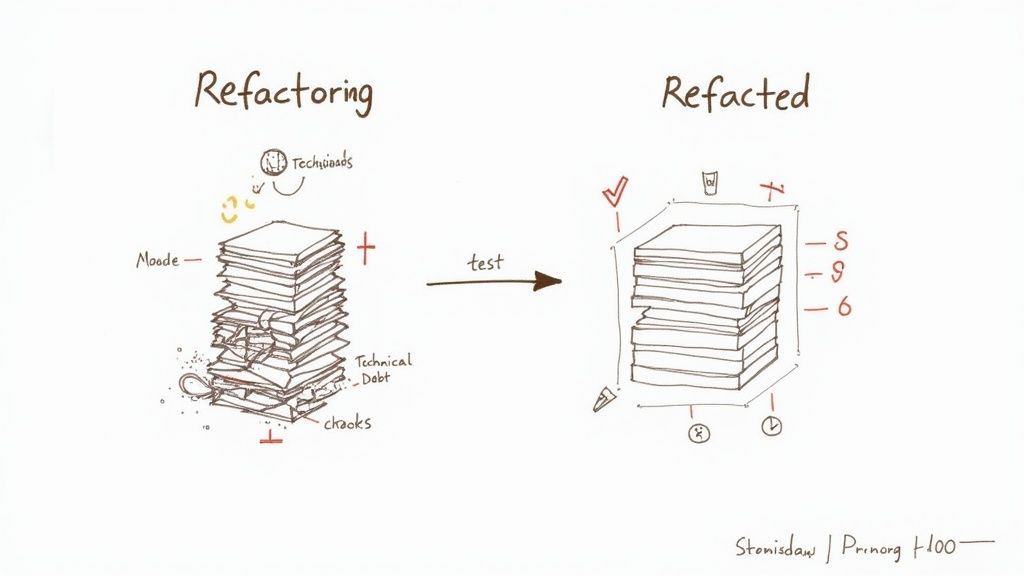
Refactoring is the disciplined practice of improving internal code structure without changing its external behavior. It's the agile equivalent of "cleaning as you go" and a critical tool for managing technical debt, which represents the implied cost of rework caused by choosing an easy (limited) solution now instead of using a better approach that would take longer. Agile teams that prioritize this practice maintain a sustainable pace and prevent the gradual decay of their codebase.
Managing technical debt proactively is one of the most important agile development best practices for long-term project health. Instead of letting poor code accumulate, agile teams allocate dedicated time to refactor, simplify complex modules, and update dependencies. This continuous improvement ensures the software remains easy to understand, modify, and extend, which is essential for responding quickly to new requirements.
Why It's a Top Agile Practice
Ignoring technical debt creates a drag on development velocity. As the codebase becomes more complex and fragile, adding new features or fixing bugs takes exponentially longer. Proactive refactoring prevents this slowdown, keeping the team productive and the product adaptable. Companies like Google, which famously allows engineers to spend 20% of their time on technical projects, and Facebook, which regularly refactors critical systems, understand that investing in code quality pays dividends in speed and innovation.
Actionable Implementation Tips
To integrate refactoring into your agile workflow, treat technical debt as a first-class citizen in your planning process. Here are some actionable steps:
- Allocate Sprint Capacity: Dedicate a consistent portion of each sprint (e.g., 10-20%) to refactoring and technical debt reduction.
- Leverage Code Quality Tools: Use static analysis tools like SonarQube or linters to automatically identify code smells, security vulnerabilities, and overly complex areas ripe for refactoring.
- Refactor While You Work: Encourage the "boy scout rule": always leave the code cleaner than you found it. When implementing a new feature, take time to refactor the adjacent code.
- Discuss Debt in Retrospectives: Use sprint retrospectives to discuss sources of new technical debt. Identify patterns and agree on team-wide strategies to prevent them in the future.
- Ensure Test Coverage: Before undertaking a significant refactoring effort, ensure you have a comprehensive suite of automated tests to verify that the changes have not altered the system's external behavior.
9. Cross-Functional Teams and Collaboration
Cross-functional teams are composed of members with diverse skills, such as developers, designers, QA analysts, and product managers, all working together toward a single, shared objective. This structure dismantles traditional departmental silos, fostering a collaborative environment where the team collectively owns the product delivery from end-to-end. This approach is a cornerstone of agile development best practices because it accelerates decision-making and problem-solving by having all necessary expertise within one unit.
The core principle is shared responsibility. Instead of handoffs between specialized groups, the entire team collaborates throughout the product lifecycle. This tight integration ensures that different perspectives, like those from user experience design best practices, are considered at every stage, from initial concept to final deployment. This holistic approach enhances communication, reduces delays, and empowers the team to innovate more effectively.
Why It's a Top Agile Practice
Cross-functional teams excel at delivering complex products by eliminating dependencies and communication bottlenecks. When all skills are in one place, the team can address challenges rapidly without waiting for external input. This structure promotes a deep sense of ownership and accountability, leading to higher-quality outcomes and faster delivery cycles. Spotify’s famous "squad" model and Amazon’s "two-pizza teams" are prime examples of how this structure enables autonomy and rapid innovation, allowing them to build and launch features at an impressive pace.
Actionable Implementation Tips
To build effective cross-functional teams, focus on creating a supportive and clearly defined environment. Here are some key tips:
- Define a Clear Team Charter: Establish and document the team's mission, goals, and scope from the outset to ensure everyone is aligned.
- Ensure Skill Completeness: Before a project begins, verify the team includes all the necessary skills (e.g., frontend, backend, design, testing) to deliver the increment independently.
- Establish Shared Metrics: Measure success based on collective team outcomes, not individual functional performance, to reinforce a shared sense of purpose.
- Promote Psychological Safety: Create an environment where team members feel safe to voice diverse opinions, ask questions, and challenge ideas without fear of negative consequences. This is crucial for leveraging the team's varied expertise.
10. Iterative Development, Minimum Viable Product (MVP) and Agile Metrics
Iterative development is a core agile principle that breaks down large projects into smaller, manageable cycles. This approach is often combined with building a Minimum Viable Product (MVP), which is the most basic version of a product that can be released to gather real-world user feedback. By pairing this with key agile metrics, teams can validate assumptions, reduce waste, and ensure they are building something customers truly want, making this trio one of the most powerful agile development best practices.
This process creates a powerful feedback loop: build a small increment, release it as an MVP, measure its performance, and use the data to inform the next iteration. This prevents teams from spending months building a product that no one needs. Instead of aiming for perfection on the first try, the goal is to learn and adapt as quickly as possible with a functional, albeit simple, product.
Why It's a Top Agile Practice
The combined power of iterative development, MVPs, and metrics lies in its ability to mitigate risk and maximize learning. It forces teams to identify and test their core business hypothesis early, saving significant time and resources. Dropbox famously started with an MVP that was just a simple video demonstrating the concept, which validated user demand before a single line of code was written for the full product. Similarly, Airbnb launched with a basic site for listing rooms, proving their core concept before investing in complex features. This data-driven, cyclical approach ensures every development effort is aligned with real user needs and business value.
Actionable Implementation Tips
To successfully leverage this trio, focus on learning, measurement, and disciplined execution.
- Define Your Core Hypothesis: Clearly state what problem you are solving and for whom. Identify the minimum features needed to test this hypothesis. This is a crucial first step before moving into rapid prototyping techniques.
- Launch and Learn Quickly: Release your MVP to a segment of real users as soon as possible. Your primary goal is to gather both qualitative and quantitative feedback, not to launch a perfect product.
- Focus on Key Metrics: Avoid "vanity metrics." Instead, track 3-5 actionable metrics (e.g., user retention, conversion rate, task completion time) that directly reflect your hypothesis.
- Be Prepared to Pivot: Use the data and feedback you collect to make informed decisions. If the data shows your initial assumption was wrong, be willing to change direction or even abandon the idea.
10-Point Agile Best Practices Comparison
| Item | 🔄 Implementation Complexity | ⚡ Resource Requirements & Speed | ⭐ Expected Outcomes | 💡 Ideal Use Cases | 📊 Key Advantages |
|---|---|---|---|---|---|
| Scrum Framework | Medium — defined roles, ceremonies and cadence require setup and training | Moderate — dedicated PO/SM/dev time; ceremonies add overhead but enable steady velocity | Predictable sprint delivery, improved team alignment, regular shippable increments | Product development with evolving requirements and cross-functional teams | Clear structure; rapid feedback loops; scalable across orgs |
| Kanban Method | Low–Medium — simple board & WIP limits; fewer prescribed processes | Low overhead; continuous flow supports steady throughput if disciplined | Reduced cycle time, better flow visibility, fewer bottlenecks | Support, maintenance, operations, teams with variable priorities | Flexible, incremental adoption; minimal ceremony; visualizes work |
| Extreme Programming (XP) | High — requires adoption of engineering practices (TDD, pair programming, CI) | High — intensive developer time, strong testing/CI infrastructure | Very high code quality, low defect rates, sustainable technical excellence | Complex, high-risk engineering projects where quality is critical | Technical rigor; prevents technical debt; fast reliable delivery |
| User Stories & Story Mapping | Low — simple formats and mapping workshops; needs good PO discipline | Low — lightweight artifacts; speeds planning and prioritization | Better product-market fit, clearer acceptance criteria, aligned priorities | Requirement discovery, roadmap planning, stakeholder communication | User-focused prioritization; bridges business and engineering |
| CI/CD | High — automated pipelines, tests, IaC and monitoring needed | High initial setup/infrastructure; enables very rapid deployments once mature | Faster time-to-market, fewer integration issues, reliable rollouts | Teams deploying frequently, DevOps-centric orgs, large-scale services | Automation of build/test/deploy; early bug detection; safe rollouts |
| Daily Standup Meetings | Low — brief daily ritual; easy to start, must be well-facilitated | Low time cost (~15 min/day); quick for coordination but must avoid drift | Faster blocker detection, improved daily alignment and accountability | Co-located or tightly synced teams needing daily coordination | Fast sync, visible commitments, fosters team cohesion |
| Sprint Planning & Retrospectives | Medium — regular meeting cadence plus prep; requires facilitation skills | Moderate per-sprint time investment; improves future efficiency | Aligned sprint goals, continuous process improvement, tracked velocity | Iterative teams using sprints aiming to improve predictability | Drives alignment and continuous improvement; actionable outcomes |
| Refactoring & Technical Debt Mgmt | Medium — needs tests, tracking and scheduled effort | Requires dedicated capacity (10–20% suggested); tooling for analysis | Improved maintainability, lower long-term costs, fewer regressions | Long-lived codebases, scaling products, teams facing slowing velocity | Sustains developer productivity; reduces future maintenance cost |
| Cross-Functional Teams & Collaboration | High — cultural reorg and shared ownership required | High — mix of skills in team; initial coordination overhead but speeds decisions later | Faster end-to-end delivery, higher quality through diverse perspectives | Feature teams, product-centric organizations, rapid delivery goals | Reduces handoffs, increases ownership, improves resilience |
| Iterative Development, MVP & Agile Metrics | Medium — requires prioritization discipline and metric systems | Moderate — investment in analytics and rapid releases; enables fast learning | Validated learning, reduced waste, quicker product-market fit | New product validation, startups, feature discovery and experiments | Early validation of assumptions; data-driven decisions; risk reduction |
Integrating Agile Practices into Your Unique Workflow
Embarking on the agile journey is less about adopting a rigid set of rules and more about embracing a fundamental shift in mindset. We've explored a comprehensive suite of agile development best practices, from the structured cadence of Scrum and the visual workflow of Kanban to the technical discipline of Extreme Programming (XP) and the collaborative power of cross-functional teams. Each practice, whether it's crafting precise user stories, implementing a robust CI/CD pipeline, or committing to regular retrospectives, serves a single, overarching goal: to deliver exceptional value to your users faster and more predictably.
The true strength of agile is not found in dogmatically following a single framework but in thoughtfully selecting and adapting these principles to fit your team's unique context. This list is not a prescriptive mandate; it is a toolkit. Your organization’s culture, the specific challenges of your project, and the skills of your team members will dictate which tools are most effective. The path to agile maturity is, fittingly, an iterative one.
From Theory to Action: Your Next Steps
The transition to a more agile way of working can feel daunting, but it begins with small, deliberate steps. Avoid the temptation to implement everything at once. Instead, identify your team's most pressing bottleneck and choose one or two practices from this guide that directly address it.
- Is your workflow opaque and unpredictable? Start by implementing a simple Kanban board to visualize work in progress and identify where tasks get stuck.
- Is team communication fragmented? Introduce the daily standup. Keep it short, focused, and consistent to build a habit of daily synchronization.
- Are you struggling with technical quality and mounting bugs? Begin incorporating principles from XP, such as paired programming for critical features or a renewed focus on refactoring to manage technical debt.
- Do your releases feel like a gamble? Focus on building a CI/CD pipeline. The initial investment will pay dividends in reduced risk, faster feedback, and increased developer confidence.
Once you’ve introduced a new practice, the agile cycle begins. Measure its impact, whether through formal agile metrics like cycle time or informal team feedback. Inspect the results during your sprint retrospectives. And most importantly, adapt your approach based on what you’ve learned. Empower your team to own this process. Their insights are invaluable for tuning these practices to your specific environment, ensuring the changes are sustainable and genuinely beneficial.
The Lasting Impact of True Agility
Mastering these agile development best practices transcends simple process improvement; it cultivates a culture of continuous learning, resilience, and customer-centricity. When teams are empowered to collaborate effectively, manage their workflow intelligently, and maintain high technical standards, they are not just more efficient. They are more engaged, innovative, and capable of navigating the uncertainty inherent in modern product development.
This is the essence of agility: removing friction to accelerate the delivery of value. It’s about creating an environment where developers can focus on solving complex problems and designers can focus on crafting brilliant user experiences. A key part of reducing this friction is leveraging smart tools that streamline repetitive tasks. For design and development teams, the constant search for consistent, high-quality icons is a common and frustrating time sink. This is precisely where modern tooling can amplify your agile efforts. By removing these small but significant obstacles, you free up your team’s cognitive resources to concentrate on what truly matters: building an outstanding product.
Ready to eliminate a common bottleneck in your design-to-development workflow? VibeIcons uses AI to generate perfectly matched, high-quality icons for popular sets like Heroicons and Lucide, ensuring visual consistency without the tedious search. Streamline your asset creation and empower your cross-functional team by visiting VibeIcons to see how you can accelerate your workflow today.